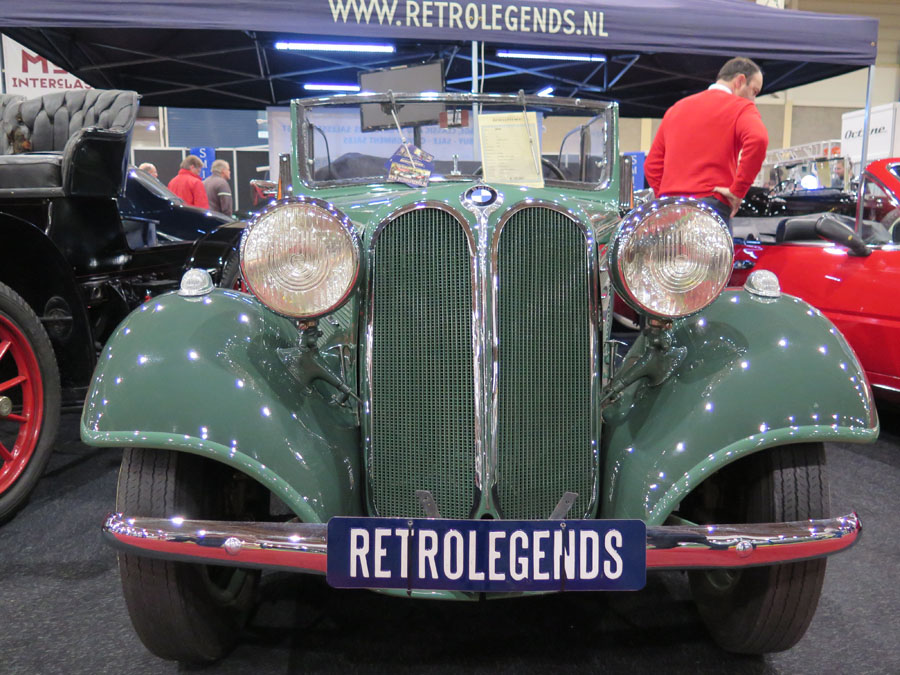
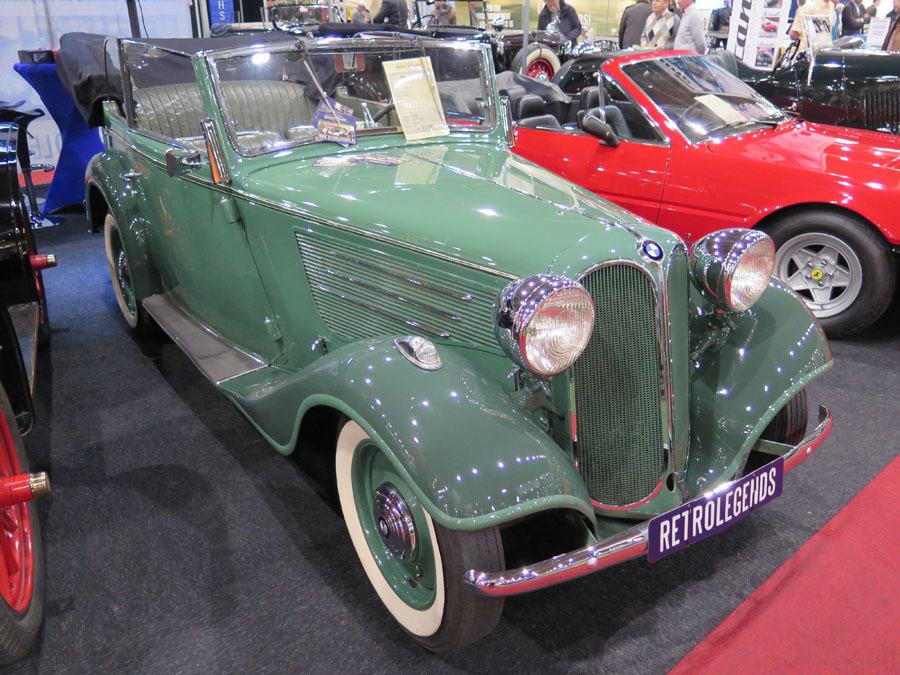

| Make and car model | BMW 319 Cabriolet |
| Production year | 1936 |
| Body type | Cabriolet, 4-seats |
| Number of doors | 2 |
| Exterior colour | green |
| Interior colour | green |
| Fuel | petrol |
| Displacement (ccm) | 1911 |
| Number of cylinders | line 6 |
| Engine power (PS at rpm) | 45 at 3750 |
| Top speed (km/h) | 115 (factory data) |
| Acceleration 0-100 km/h (sec.) | unknown |
| Gearbox type | manual, 4-speed |
| Fuel consumption, combined driving (l/100 km) | unknown |
| Mileage | unknown |
| Number of produced copies | 6 468 copies of model 319 from 1935 to 1937, of which 75 copies of model 319 Cabriolet (open with 4 seats) |
| Price (€) | 79 000 |
B.M.W. (Bayerische Motoren Werke AG) (founded 1916) is a German manufacturer of automobiles, motorcycles and bicycles with headquarters in Munich. The company in 1916 in Munich was founded by Karl Friedrich Rapp as Bayerische Flugzeugwerke (BFW) (Bavaria factory aircraft), which in 1917 renamed the Bayerische Motoren Werke (BMW GmbH) (Bavaria engine factory), to two months before the end of the First World War became a joint stock company. One of the three people who contributed to the founding of the first Managing Director from 1922 to 1942 was Franz Josef Popp (1886-1954). BMW is known for its double "kidneys" on the front cover, which were initially narrow and modern cars wide, then the Hofmeister kink - known complete rear window of the C part of the body first shown in 1961, the BMW 3200 CS model. The interior design is known for the cockpit oriented towards the driver who debuted at the first generation of the 5 Series, and today BMW call it, "BMW's traditional driver-oriented cockpit." BMW bought in 1966 the company Hans Glas based in Dingolfing, Germany, which from 1905 to 1908, was known for the successful production of a sewing machine. The company Glas was known for small cars, such as the model Goggomobil, which was produced from 1955 to 1969. However, the company Glas was also producing a very stylish sports coupe models 1300 GT and 1700 GT, which were produced from 1963 to 1968, and soon after them exclusive sports models with a V8 engine, 2600 GT and 3000 GT, which were produced from 1966 to 1968, designed by the famous Italian car body workshop Pietro Frua (1913 to 1983), and who designed the bodies for many famous car manufacturers, during the 1950s and 1960s, and models of Glas 2600 GT and 3000 GT with a V8 engine, because of the similarity of design Pietro Frua with Maserati models, are called, 'Glaserati' '. Glas models have had their logo, except the model 3000 GT, which had ahead and behind, a BMW logo. In 1968 BMW created their own large coupe, the BMW 2500 CS, and this meant the end for Glas. In 1992, BMW acquired a large stake in California based industrial design studio Designworks USA, which they fully acquired in 1995. In 1994, BMW bought the British Rover Group (which at the time consisted of the Rover, Land Rover and MG brands as well as the rights to defunct brands including Austin and Morris), and owned it for six years. By 2000, Rover was incurring huge losses and BMW decided to sell Rover together with MG. The MG and Rover brands were sold to the Phoenix Consortium to form MG Rover, while Land Rover was taken over by Ford. BMW, meanwhile, retained the rights to build the new Mini, which was launched in 2001.

